
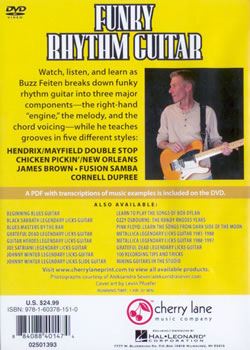
 Mr. Feiten starts us off with a Jimmy Nolan sex machine right hand strum where we 'scratch' which is when we don't articulate the chord with left hand fingers.
We don't press down on the strings. Somebody forgot to explain his wet guitar and amp settings to us so we have to guess. He also goes a bit too fast.
He wants us to get the 'feel'. He says very plainly that the rhythm and the feel or the engine is more important than the notes.
You need the engine. Then comes the melody and then the chord voicings.
That and 50 cents will get you a cup of coffee so where do we start?
Anyway thru the course of showing us funkified riff there is a harmonic pickup that he gets around to explaining which is a big help since he plays it a little fast.
As well as some cool walking funk bass line embellishments that make this worth while and as though you actually may one day to be able to sound like James Brown's guitar player Jimmy Nolan.
He goes a little fast for some reason. Next we get to James Brown II or Music 4: which is another funk lick but more melodic and interesting in its way but ....
The inimitable guitar style of Texas born Cornell Dupree's is next in D flat? I think its D flat because no one tells us. The pamphlet says its in D/E. Question not that all adulants need to learn these techniques if we want to play soulful Rhythm and Blues and who doesn't?
This is a smokier way to tickle notes out of the old girl. Its pulse and resolutions less rigid and since it uses these embellishments they have to be hung on something rhythmic like maybe a soulful ballad. 21:43 Harmonizing the 4ths of the diatonic scale.
The late Cornell Dupree was a revered professional session guitar player. Living players like session ace Tommy Tedesco or even Buzz himself, are studio song-chart music reading guitar masters you have heard a million times but maybe never heard of by name.
These people most likely grew up sight reading or with musical backgrounds or both. I have read Tommie's book and as a youth he studied guitar with diligence. The support from his family was key to him learning to read and a lot more!
"I want to stay as close to the edge as I can without going over.
Out on the edge you see all kinds of things you can’t see from the center." --- Kurt Vonnegut